
Destinations
Seeing the Northern Lights in January
January gives you the longest nights of the aurora season — but most failed trips fail for reasons that have nothing to do with the sun. Here is how to stack the odds.
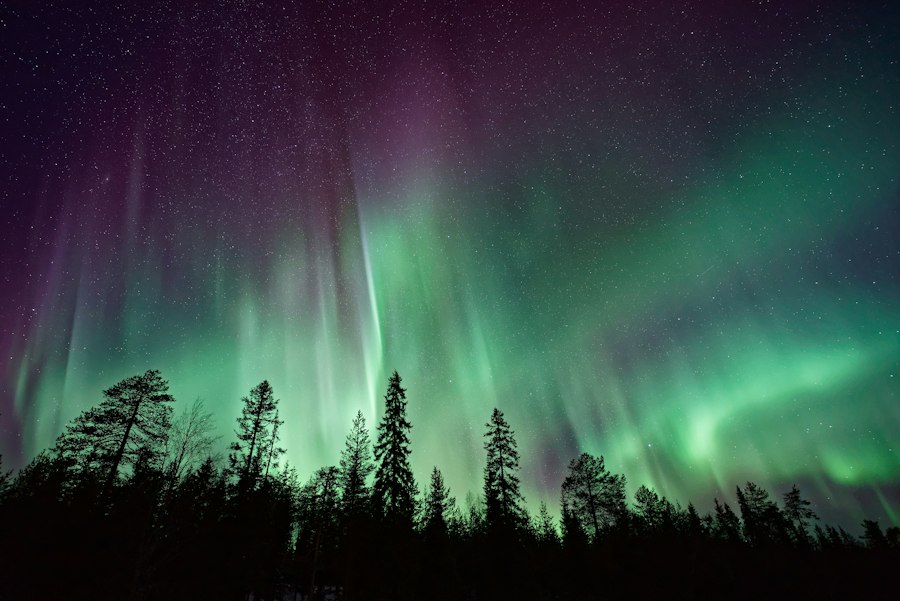
Most people who come home from an aurora trip without seeing anything did not have bad luck with the sun. They had three nights, one location, no flexibility, and clouds. Aurora travel is a probability exercise, and almost all of the probability is under your control before you leave.
January is a good month to run that exercise. Here is how to do it properly.
Why January works
Three things have to line up: darkness, clear sky, and geomagnetic activity.
January delivers the first one emphatically. Inside the Arctic Circle you get somewhere between very little daylight and none at all, which means a viewing window that runs from mid-afternoon to breakfast rather than a narrow slot around midnight. More dark hours is more chances per night.
It is also reliably cold, and deep cold usually means dry, stable air — which helps with the second condition. What January cannot promise is the third. Geomagnetic activity is not seasonal, and nobody can forecast it usefully more than a few days out.
One myth worth killing: the equinoxes in March and September do see slightly elevated geomagnetic activity on average. That is real but small, and in March you trade it for far shorter nights. January’s darkness advantage is larger than the equinox effect.
Choosing where to go
| Destination | Jan avg temp | Getting there from the UK | Character |
|---|---|---|---|
| Finnish Lapland (Rovaniemi, Kittilä, Saariselkä) | −12°C | 3h 30m direct in season | Forest, snow, strongest cold |
| Tromsø, Norway | −4°C | ~5h via Oslo | A real city with fjords and mountains |
| Lofoten, Norway | 1°C | ~6h via Oslo/Bodø | Mildest, most dramatic scenery |
| Abisko, Sweden | −11°C | Long transfer via Kiruna | Famous “blue hole” microclimate |
| Iceland | 0°C | ~3h direct | Easiest access, cloudiest odds |
Finnish Lapland
The most developed for tourism, with the best odds of cold clear nights and the largest supply of glass igloos and aurora cabins. It is also the coldest on this list by a distance — genuinely −20°C to −30°C some nights, which is a different category of experience.
Best for: first-timers who want the full snow-and-huskies package alongside the aurora.
Tromsø
The pragmatic choice. It is a proper city with restaurants and a university, so a cloudy night is not a wasted evening. Crucially, it sits at a road hub — guided chases can drive two or three hours inland, or towards Finland, to get out from under the cloud. That mobility is worth more than most people realise.
Best for: travellers who want an insurance policy against weather.
Lofoten
Warmed by the Gulf Stream, so around freezing rather than −25°C. You get aurora over jagged peaks and red fishermen’s cabins, which is the most photogenic combination anywhere. Coastal weather is changeable, but the scenery justifies the trip regardless of whether the sky performs.
Best for: photographers, and anyone who dislikes extreme cold.
Iceland
Easiest to reach and the weakest odds. Iceland is further south than the others and considerably cloudier, being an island in the North Atlantic. A wonderful trip in its own right — just do not make the aurora the only reason you went.
The planning rules that actually matter
Stay at least four nights, ideally five. This is the single highest-impact decision. On a three-night trip a single weather system can take out your entire window. Each additional night compounds your odds substantially.
Get away from town lights. Even a modest amount of light pollution washes out a weak display. A guided chase or a rural cabin is worth far more than a hotel with “aurora views” in the brochure.
Book a guided chase for at least one night. Good operators check cloud forecasts through the afternoon and drive to the gap. You are paying for local knowledge and a vehicle, and that is exactly what converts a cloudy forecast into a sighting.
Book accommodation before flights. This is the reverse of every other trip we plan. Aurora accommodation sells out four to six months ahead; flights to Rovaniemi, Kittilä and Tromsø stay reasonable much later. Secure the bed first.
Check the forecast tools, but do not obsess. The Kp index is a rough global indicator, not a local prediction. Cloud cover is the variable that will actually decide your night.
Managing the expectation
The honest version: a strong display is not the green curtain you have seen photographed. Cameras gather light over several seconds; your eyes do not. A moderate aurora often looks like a pale grey-green arc to the naked eye, and only resolves into colour on the back of a camera.
This disappoints people who were not warned. It should not. A strong substorm — when the arc breaks up and starts moving fast across the sky — is unmistakable and genuinely extraordinary. It just is not every night, and it is not most nights.
What it costs
January flights to the Arctic follow the usual January dip and are often the cheapest part of the trip. Accommodation does not — glass igloos are a premium product in peak season and priced accordingly.
If budget is the constraint, Tromsø with a regular hotel plus two guided chases will usually deliver better odds per pound than a single night in a glass igloo in Lapland. The igloo is a wonderful experience; it is not an aurora strategy.
Related reading
- The January packing list — the Arctic half, in detail
- The best places to travel in January — how aurora trips compare to winter sun
- When to book January flights — why aurora trips break the normal booking rules
We plan aurora trips to all five destinations above, and we will tell you honestly which one fits your tolerance for cold and your budget. Start here, or see the full destination guide.
Keep reading

Destinations
Short-haul winter sun — where is genuinely warm within five hours
Plenty of places are marketed as winter sun. Far fewer are genuinely warm in January. Here is what the climate data says, within five hours of the UK.
Read more →
Flight Deals
The cheapest week to fly in January, week by week
January is not one price. It is four very different weeks wearing the same name, and the gap between the most and least expensive can be larger than the fare itself.
Read more →